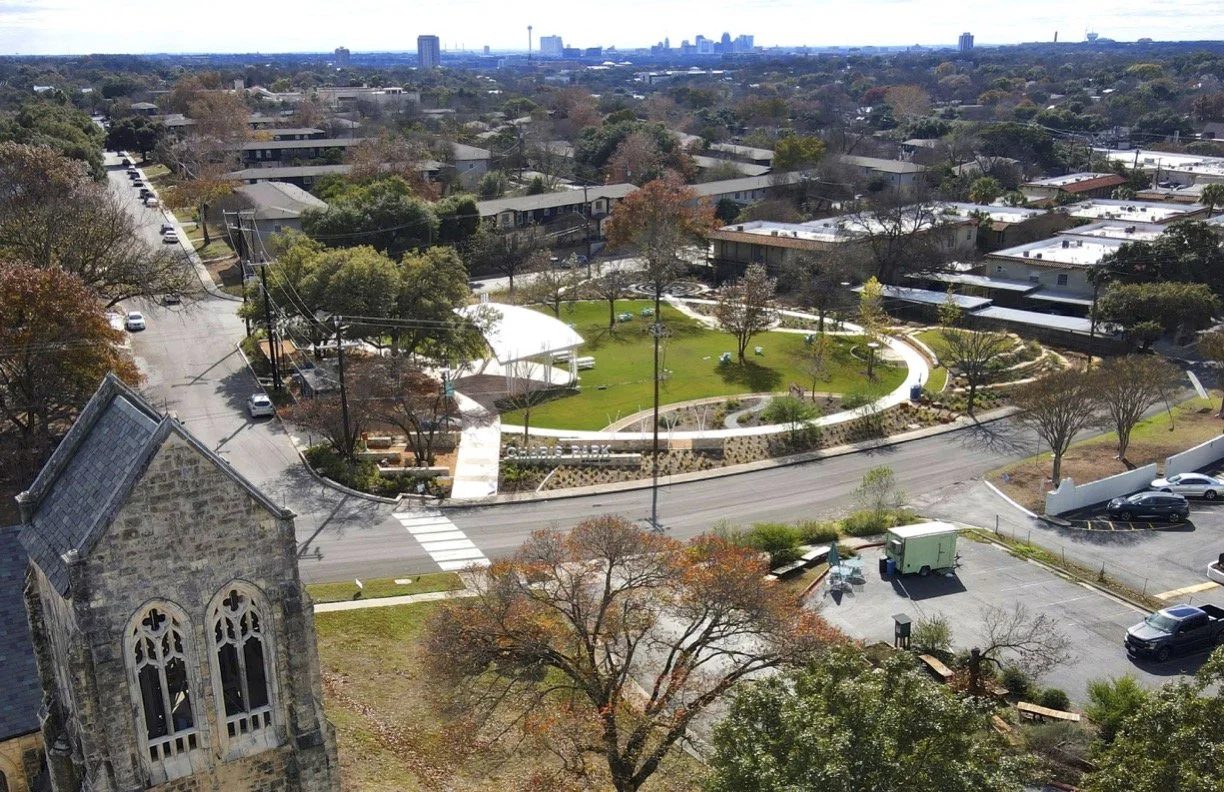
Sunset Ridge Collective & Charis Park
The Challenge
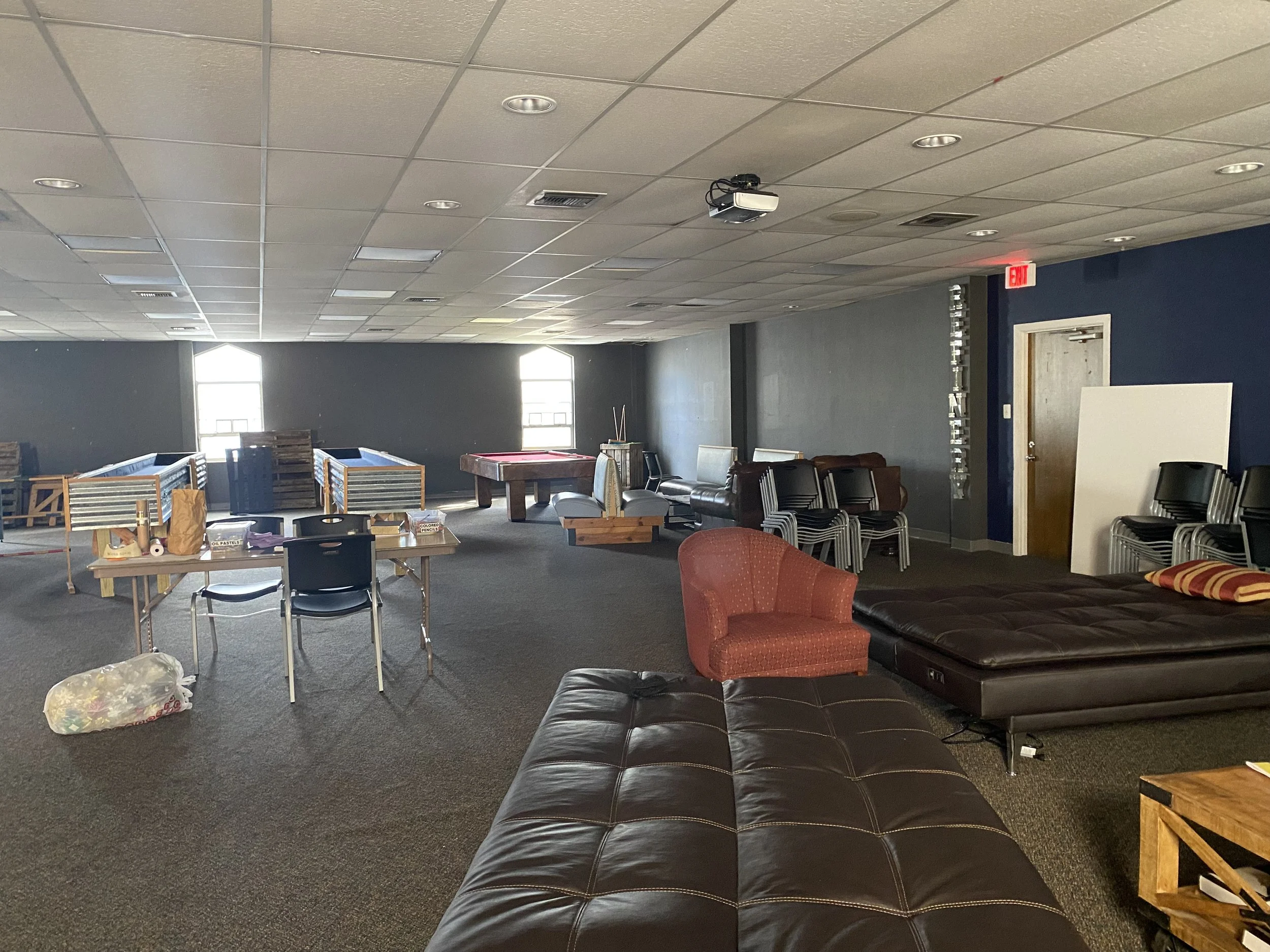
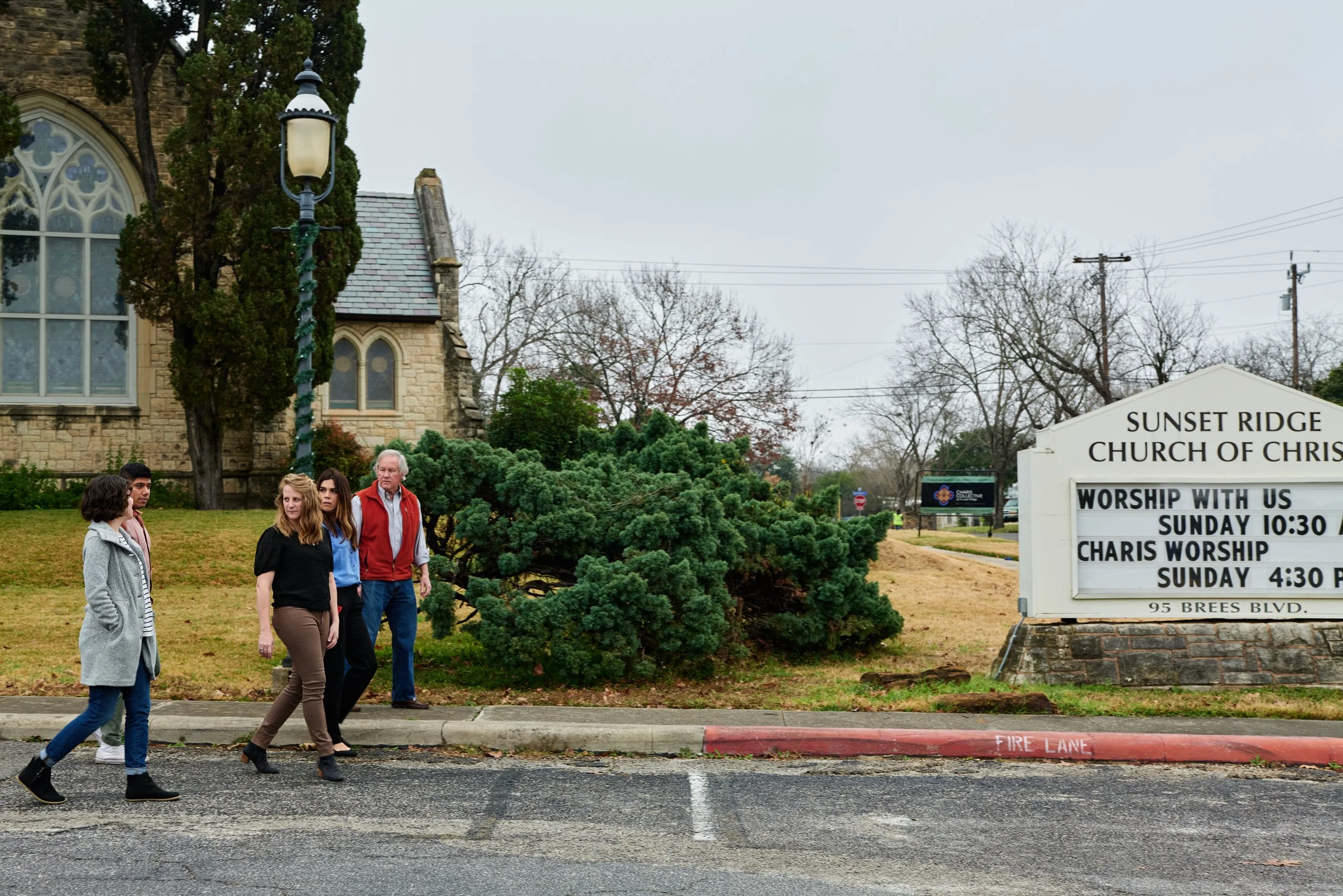
Like many legacy faith communities in San Antonio and around the country, Sunset Ridge Church found itself in crisis. A 70-year-old fixture in the city’s Alamo Heights neighborhood, the congregation was facing challenges that have become a quiet epidemic for aging faith communities across America. Once a thriving center of activity, the church was by 2018 grappling with a shrinking congregation and a mounting budget deficit. On the church’s 4.26-acre campus, a historic chapel, a “modern” (in 1965) sanctuary, and buildings that once housed bustling classrooms sat virtually empty six days a week.
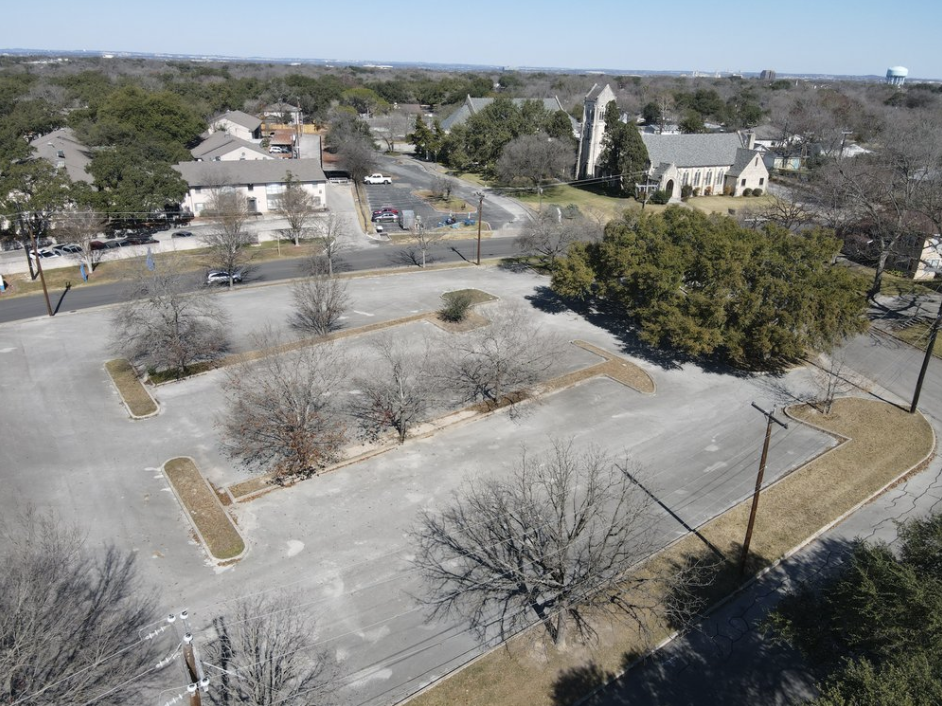
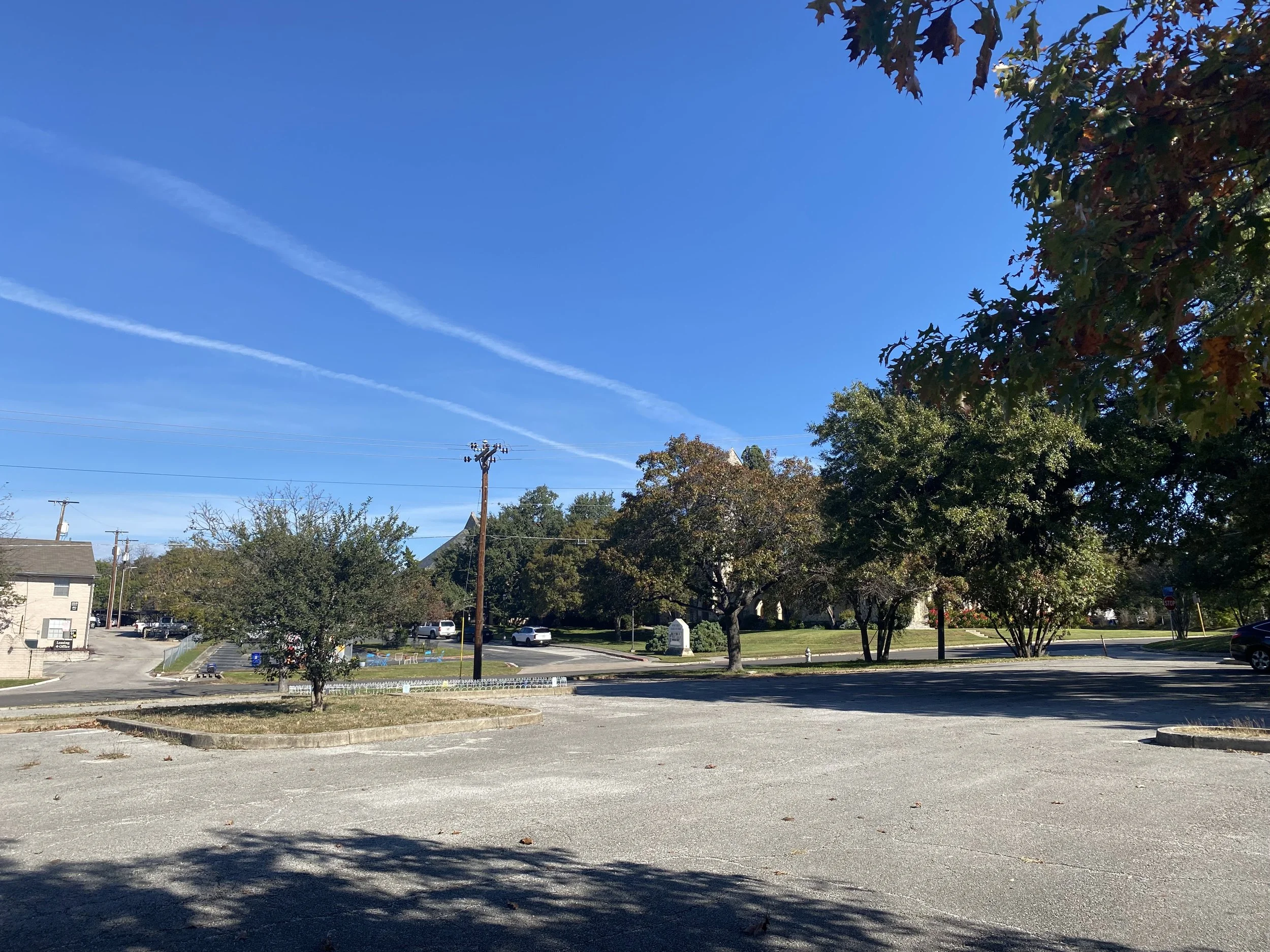
However, one of the most obvious signs of struggle could be seen across the street: a massive, one-acre asphalt parking lot that sat almost completely unused. Over decades of shifting demographics, culture, and climate, the buildings had become outdated and underused, while the lot had devolved into a heat-trapping expanse of hard-to-maintain, unsustainable "grey infrastructure" that did nothing to serve a neighborhood suffering from rising social disconnection and a lack of communal spaces.
Sunset Ridge is not the only congregation facing situations like these. Faith communities across San Antonio own an estimated 3,000 acres of underutilized property. It would have been understandable then that the sum of these challenges could have prodded Sunset Ridge’s leaders toward resignation and abandonment. But with a shift in perspective and a willingness by leadership, a different path was taken.
The turning point came when the leadership—a team led by Executive Director Jess Lowry and Deputy Director Taylor Bates—altered its problem-solving paradigm from survival to service. “We had to shift the core question from ‘How do we save the church?’ to ‘How can we serve our neighborhood with the resources we already have?’” Bates recalls. “That shift changed everything. We stopped seeing our limitations and started seeing latent assets waiting to connect with real community needs.” This shift from a mindset of scarcity to one of stewardship was the spark for Sunset Ridge to pursue flourishing in a new way.
In 2021, Sunset Ridge partnered with The Impact Guild as part of a Make Good Fellowship. During that program, the church solidified the vision and the strategic language to pursue a holistic rebirth: empty spaces into thriving places; parking lots into parks; outdated programs into innovative opportunities; isolation into community. By reimagining a vacant parking lot not as a liability but as a neighborhood gift and run-down rooms as laboratories of creativity, Sunset Ridge began a transformation that would eventually bridge the gap between their underutilized resources and the profound need for community flourishing, while also charting a course that others can follow.
The Impact Guild Approach
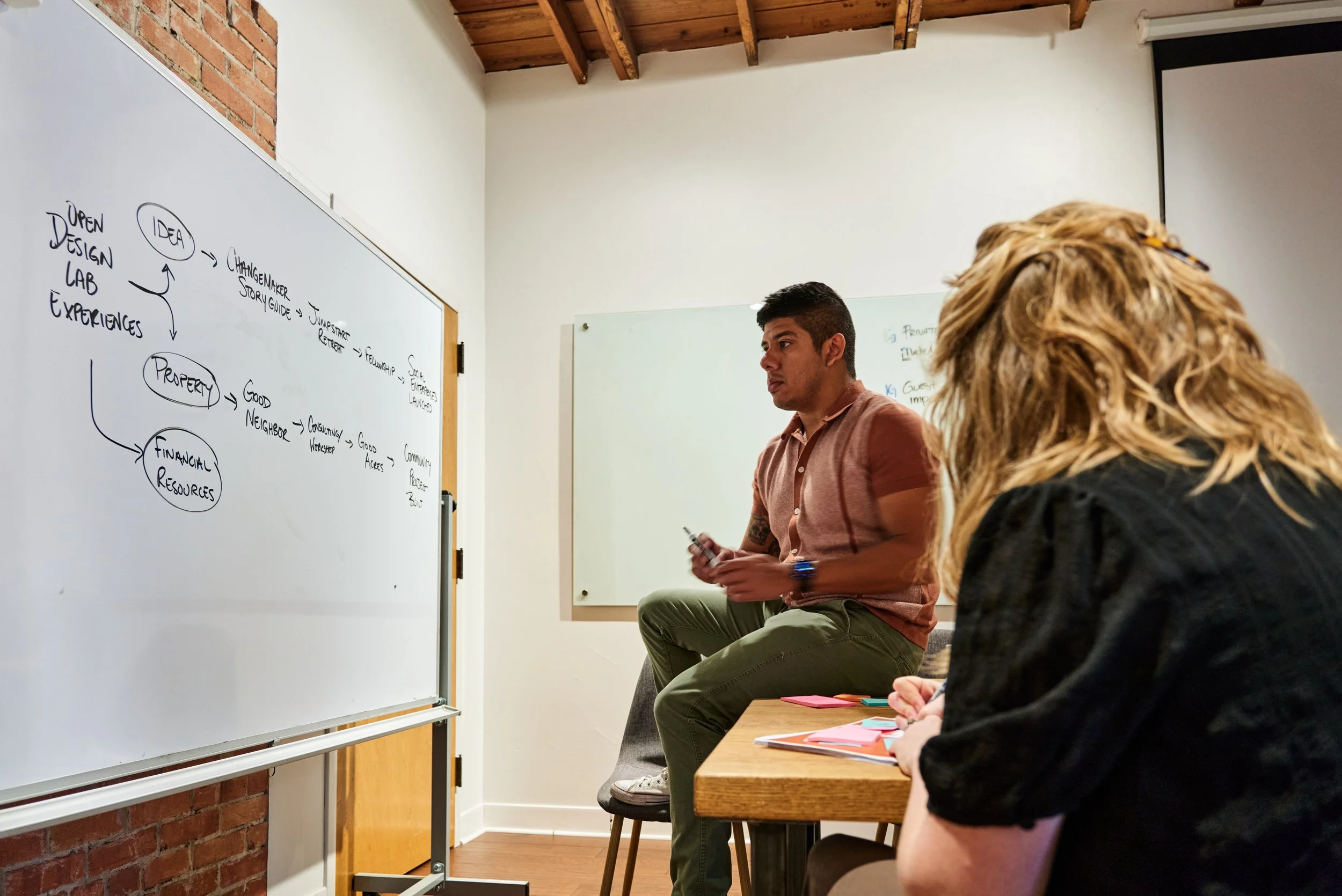
The shift at Sunset Ridge followed a clear, replicable process designed to convert underutilized real estate into social infrastructure. This approach is at the core of the work The Impact Guild does in San Antonio.
Since its inception, The Impact Guild has operated at the intersection of social innovation and physical space, serving as a bridge between visionary ideas and practical implementation. “We have operated a coworking space, organized workshops and connection events, and rallied neighbors to action since 2017,” says Executive Director Sarah Woolsey. “Along the way, the highly collaborative nature of our efforts connected us with faith communities in our city and beyond, and an unmet need began to come into focus: ‘How can houses of worship repurpose their underutilized assets to better serve their communities?’”
The Good Acres Program
To answer this question, The Impact Guild developed Good Acres—a structured program and a growing network of congregations and partners committed to putting underutilized property to work for their communities. Through work ranging from focused consulting to monthly workshops and field trips, this specialized initiative helps faith communities and nonprofits navigate the complex journey of property activation. For Sunset Ridge, the entry point was the Make Good Fellowship, a cohort-based program designed by Rooted Good and facilitated by Good Acres to help congregations clarify their vision for social enterprise and give them the professional language and direction needed to reimagine their footprint and role in their community.
“By 2022, the Collective had a clear vision and the will to act,” Woolsey recalls, “so Good Acres came alongside to facilitate the process, helping navigate the decisions, partnerships, and planning that would turn that vision into Charis Park.” The process was deeply collaborative, designed to ensure the neighborhood has a real voice in shaping the space, starting with the unused parking lot. Good Acres assembled and facilitated a six-person community visioning team—comprised of congregants, staff, neighbors, and local business owners—to define the mission and design priorities for what would become Charis Park. This team identified 12 key program elements before Good Acres managed the “request-for-proposal” (RFP) process to select Coral Studios as landscape architects and lead designers for the project.
While the physical design took shape, an equally important foundation was being laid relationally and economically. A partnership with Rose Hip Coffee—a neighborhood coffee truck in search of a home—brought a warm, recurring presence to the site and gave neighbors a natural reason to gather. It was also an early proof of concept that social enterprise could be woven into the mission's fabric from the start. Sunset Ridge staff leaned into this intentionally, showing up as hosts and neighbors, prioritizing time and relationship-building as core to the mission. Long before the park was complete, the community was already forming and demonstrating the model’s potential.
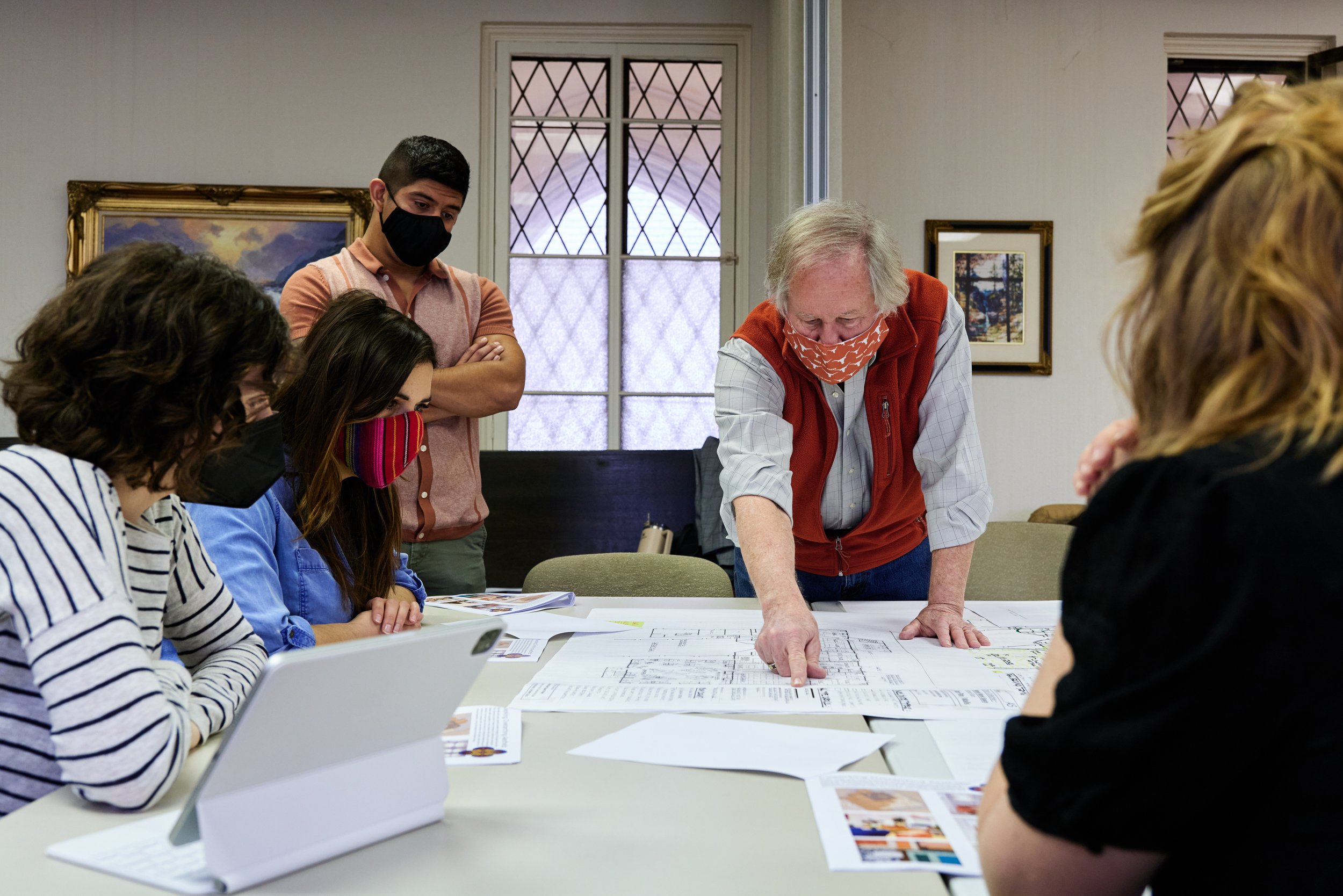
The successful planning for the park served as proof of concept for the even more ambitious phase focused on the church’s campus proper. In 2023, Good Acres scaled its processes to facilitate the renovation of the entire Sunset Ridge Main Campus, including a preschool, coworking and office space, a commercial kitchen rental, a wedding venue, and the continued provision of worship services and spiritual formation through the church. High points of this adaptive reuse endeavor included convening a nine-person building committee, facilitating broad community input sessions, and producing the complex programming documents and zone diagrams required to manage a full architectural and engineering RFP campaign, which selected Ford Powell Carson as the project’s partner. By acting as the strategic connective tissue between the congregation's mission and the technical demands of construction, Good Acres provided the steady hand necessary to navigate a multi-year transformation.
The Community Flourishing Framework
To guide reimaginations like these, The Impact Guild has developed a framework rooted in the “Social Determinants of Health” (SDOH). Simply put, these determinants are the conditions that shape how people are born, grow, live, work, and age, as well as whether they have meaningful access to economic opportunity, self-determination, and other resources. Often used in clinical settings, the determinants—which can include everything from socioeconomic status and neighborhood to economic potential, social support networks, and access to education and health care—are evaluated to establish a holistic estimate of an individual’s potential to thrive. Instead of focusing solely on physical health to understand a person’s potential to flourish, this model has proven highly effective at predicting outcomes and offering a roadmap to increase the likelihood of positive ones. So Woolsey says The Impact Guild asked, “How could this paradigm be applied to community development?”
The answer was found in what is called the “Community Flourishing Framework.” Its pillars are defined as:
Neighborhood & Built Environment: the physical spaces where people live, work, and gather that shape and connect daily life
Community Connection: the intentional work of building relationships that foster belonging, resilience, and shared support
Economic Mobility: the pathways for families to build financial stability, dignity, and opportunity
Learning & Education: the shared ways communities learn, grow, and carry wisdom forward
Health & Well-being: the conditions that nurture thriving bodies, minds, and spirits
Good Acres uses these five pillars as a design and programming compass—a way of grounding every bench, trail, classroom, and program in a specific, measurable community need.
The Framework in the World
The Sunset Ridge Collective project serves as a roadmap for community redevelopment by bringing to life a living, circular ecosystem rather than a simple real estate project. It provides a tangible proof point: when a faith community stops viewing its property as a private compound and starts treating it as a neighborhood focal point, a cycle of regeneration can begin.
This metaphor comes to life at Sunset Ridge as a measurable reality in which every investment in the land cycles back into the lives of the people. The shade of the trees cools the neighbors who gather for the market; the market provides the economic fuel for local vendors; those vendors, in turn, become the new face of a campus once hidden behind an asphalt expanse. “By refusing to look at social challenges in isolation, Sunset Ridge Collective created a space where all five pillars of the Community Flourishing Framework reinforce one another,” Woolsey emphasizes. “The project demonstrates that the most efficient way to close the gap between underutilized resources and neighborhood needs is to replace the institutional gate with a community invitation.”
Pillar 1: Neighborhood & Built Environment
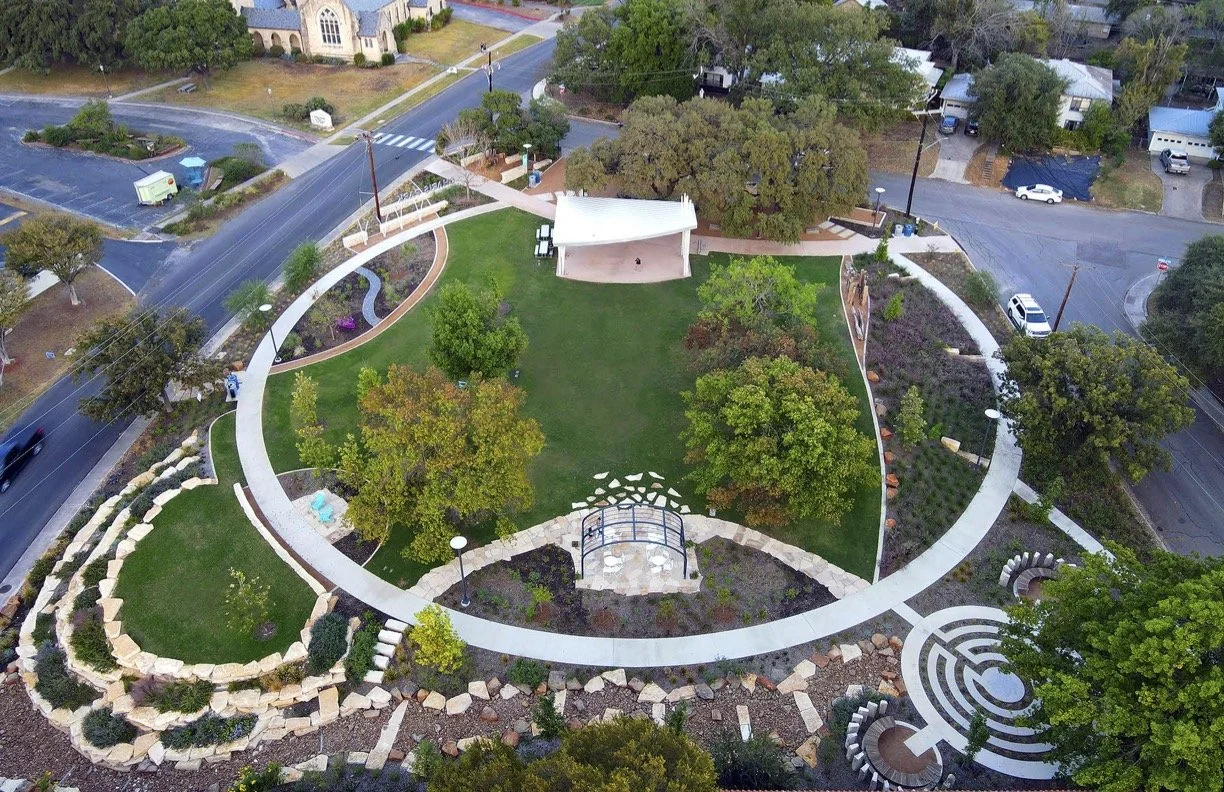
To see this restorative cascade in its most literal form, one must start where the space was most visibly broken: the neighborhood and built environment. The transformation of the physical site required a fundamental shift in how the land was expected to perform. Kaidan Nguyen, a partner at Coral Studio, describes the project as a rare opportunity. "Converting a parking lot into a park is a project that you don’t typically see in our industry," Nguyen says. "The language in the RFP included a vision for a space for community connections, spiritual growth, environmental sustainability, and material reuse. All these things aligned with our company philosophy and values."
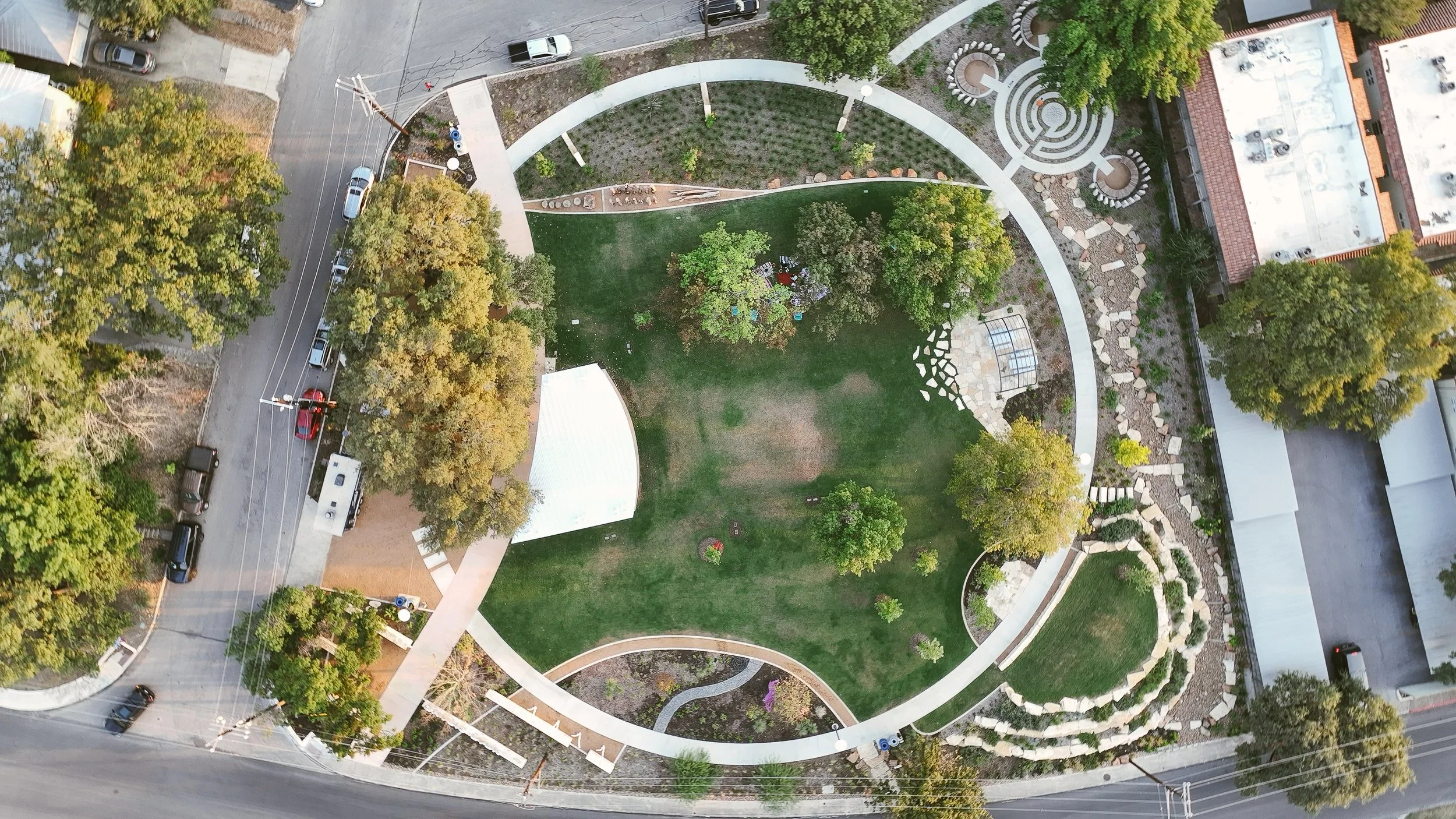
Before the project began, the one-acre parking lot contributed to the city's infrastructure burden. It was a 90% impervious surface that funneled untreated water into storm sewers. Equipped with their values and clear vision, the Collective chose to prioritize ecological health and follow Coral Studios’ plan to convert the lot into over 80% pervious green space. This shift achieved an 852-gallon-per-minute reduction in stormwater runoff and lowered surface temperatures by up to 62º, effectively turning a heat island into a cooling station for the neighborhood.
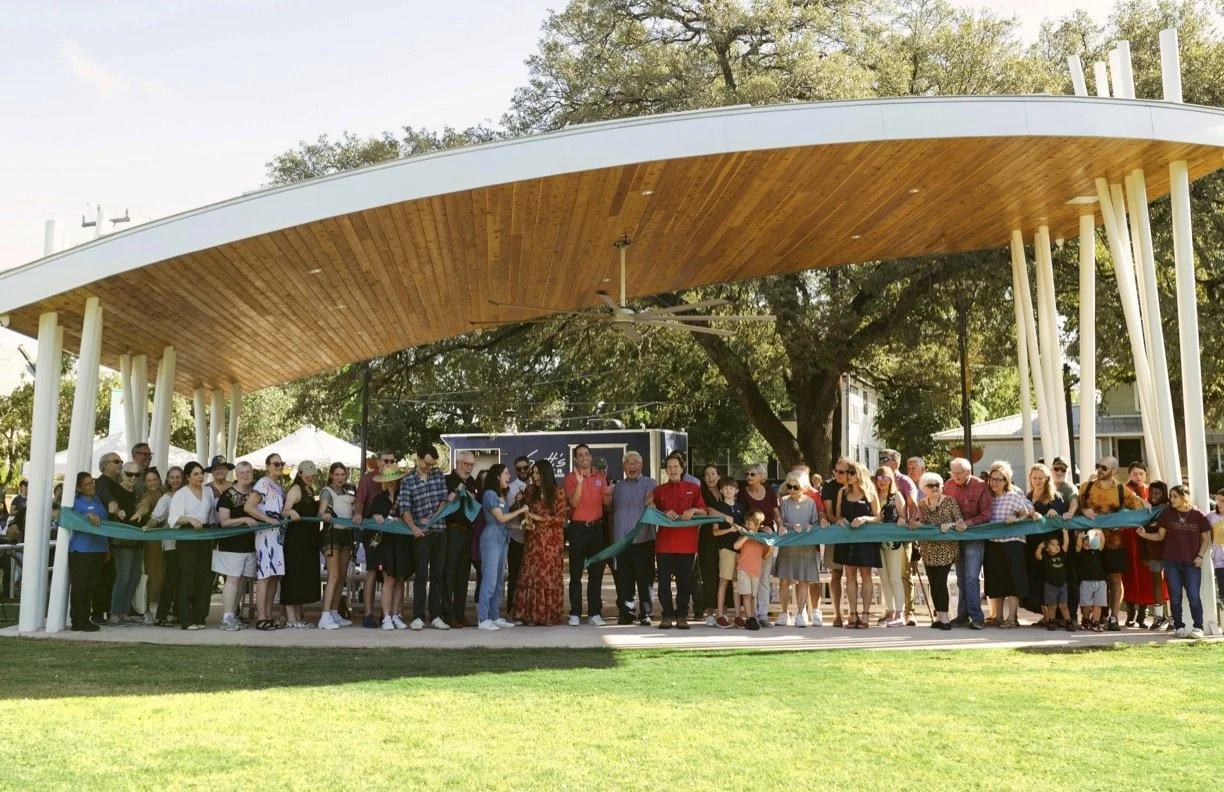
The commitment to sustainability centered on material circularity, keeping 13,154 cubic feet of demolition debris out of local landfills. Rather than hauling the old parking lot away, the team transformed the debris into the landforms, rolling hills, and earthworks that now give the park its topographic character. The project salvaged over 300 linear feet of concrete curbs to serve as seat enclosures in the meditation garden and repurposed old cedar and elm trees into log art, seating, and an informal playscape for kids.
An important aspect of the work is the idea of healing, drawing on the site’s history as a grassland and a Woodman of the World Memorial Hospital. "We wanted to tell that story in the park with the ornamental grasses, rolling landscape hill, bike racks to look like grass stalks, pavilion with the rolling roof and grass stalk posts, and limestone boulders at the rock garden,” Nguyen explains. "For the Memorial Hospital, it was important to create spaces that heal not only physically but also mentally and emotionally, which was the inspiration for the meditation garden."
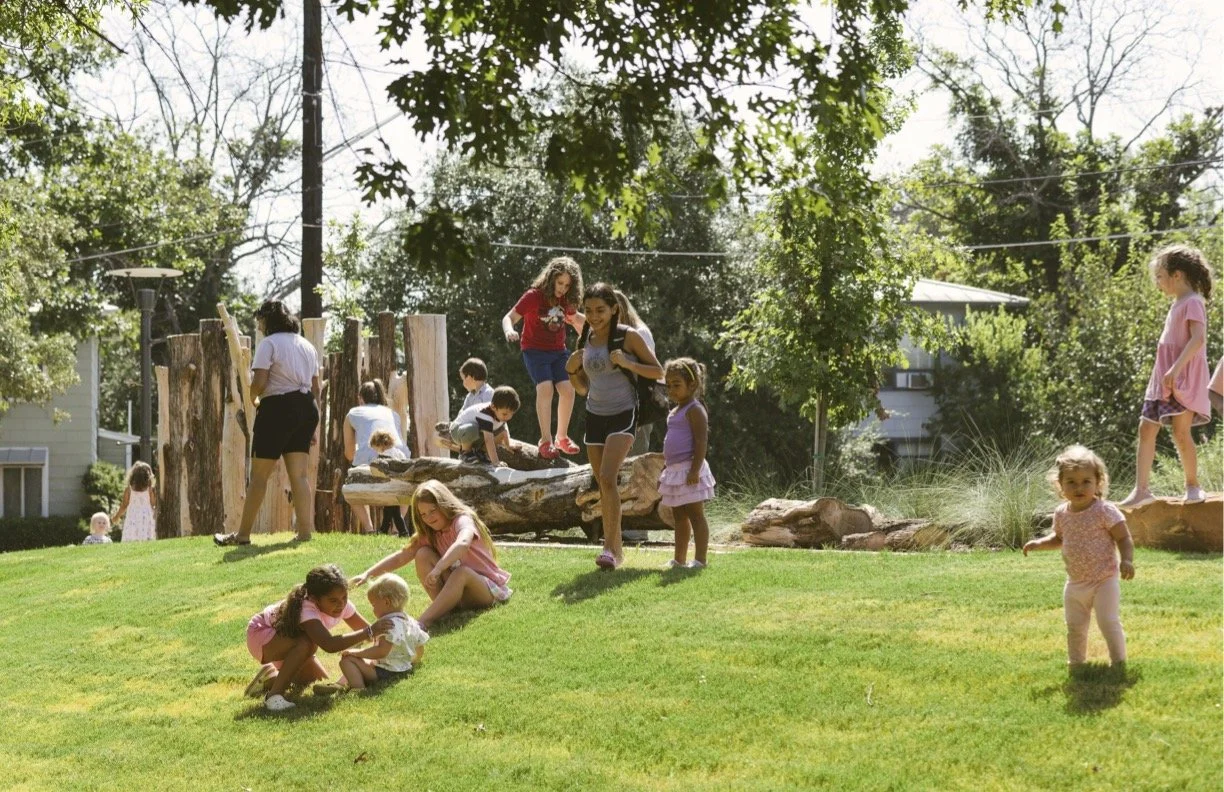
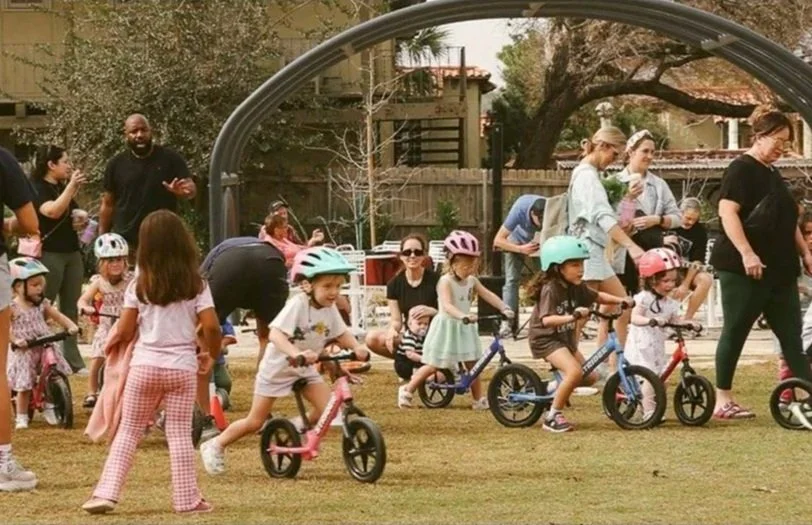
The restoration idea is further anchored by a concrete circular trail that serves as the park's architectural spine. Nguyen describes the orbit as representing "movement, life journeys, and life cycles with all the programmed spaces connecting to the circle." Unlike traditional parks with static, plastic play equipment, Charis Park was designed as an inclusive space where play is everywhere. By emphasizing exploration and curiosity, the environment itself encourages children and neighbors to connect organically.
Ultimately, Charis Park demonstrates that the built environment can be a catalyst for restoration. As Nguyen puts it, “Our hope is that this park is a catalyst for building a stronger church and community, and is an example of how an underutilized space that is thoughtfully designed can have a huge positive impact in the lives of its people in the community."
Pillar 2: Community Connection
This physical transformation provided the necessary foundation for the project’s most critical objective: addressing the epidemic of loneliness. Long before the first shovel hit the ground, the vision team identified deep social disconnection as the defining challenge of the neighborhood—a reality that predated the pandemic and transcended typical demographic lines. The goal was to move away from attractional church features designed to pull people in for a single hour on Sundays and toward a “living commons" designed for daily, spontaneous community connection.
By prioritizing communal spaces over single-use draws like splash pads, the design invited a different kind of engagement. The gathering lawn, pavilion, and pocket gardens were structured to encourage neighbors from the three nearby apartment complexes and local young families to coexist. Coral Studios’ design reflected this shift by creating an inclusive space where diversity is celebrated, and neighbors can connect. He explains that this was achieved through "...the design of the long community table where you can sit with your neighbors, lots of seating opportunities, gaming opportunities, spaces for special events and programming, and spaces that cultivate an alternative way to play by exploration and curiosity where kids can play together organically.”
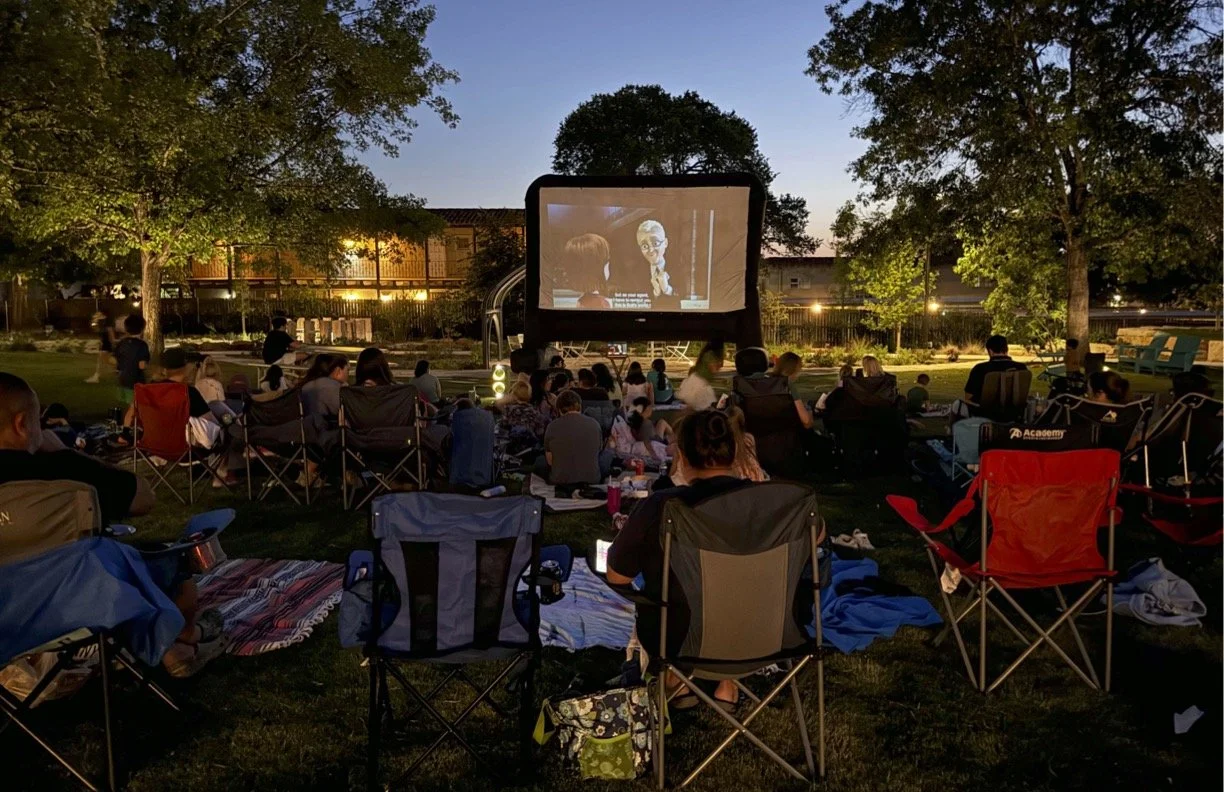
The results of this shift are visible in the way the community has claimed the space as its own. Strategic lighting supports the pavilion and food truck areas, but the space's safety is primarily maintained by the community rather than surveillance. Vandalism is virtually non-existent, not because of oversight, but because neighbors see the park as their own backyard. One “trust indicator" that might be missed demonstrates perhaps the truest metric of success: children now leave toys and personal belongings in the park overnight, confident they will be there when they return.
This intentionality has also transformed the campus into a “resilience hub,” a space the community relies on for emergency preparedness and during acute events such as cold snaps, heat waves, and other emergencies. This designation was formalized by its role as a Climate Ready Neighborhood “Point of Distribution” (POD) and a deep partnership with the local Neighborhood Association.
By providing a hub where people of diverse experiences and perspectives can share a coffee, a pizza, or a stroll along the circular trail, the Collective proved that social infrastructure is the most effective cure for isolation. And this environment of belonging created a powerful byproduct: the revitalization of the congregation itself. Sunset Ridge Church saw its membership surge from 80 to 500 people in just 18 months. This growth was never the project's primary goal; rather, it was the natural result of neighbors being drawn to a community that had stopped simply talking about its mission and started really living it.
Pillar 3: Economic Mobility
This movement from social belonging to systemic change is clearly evident in the way the campus functions as a circular marketplace. Rather than treating their property as a real estate asset to be sold for short-term cash, the Collective’s leadership chose a path of regeneration. By keeping the land in community hands and investing in a neighborhood hub, they transitioned from traditional church expenditures to a self-sustaining ecosystem of economic mobility and community wealth-building.
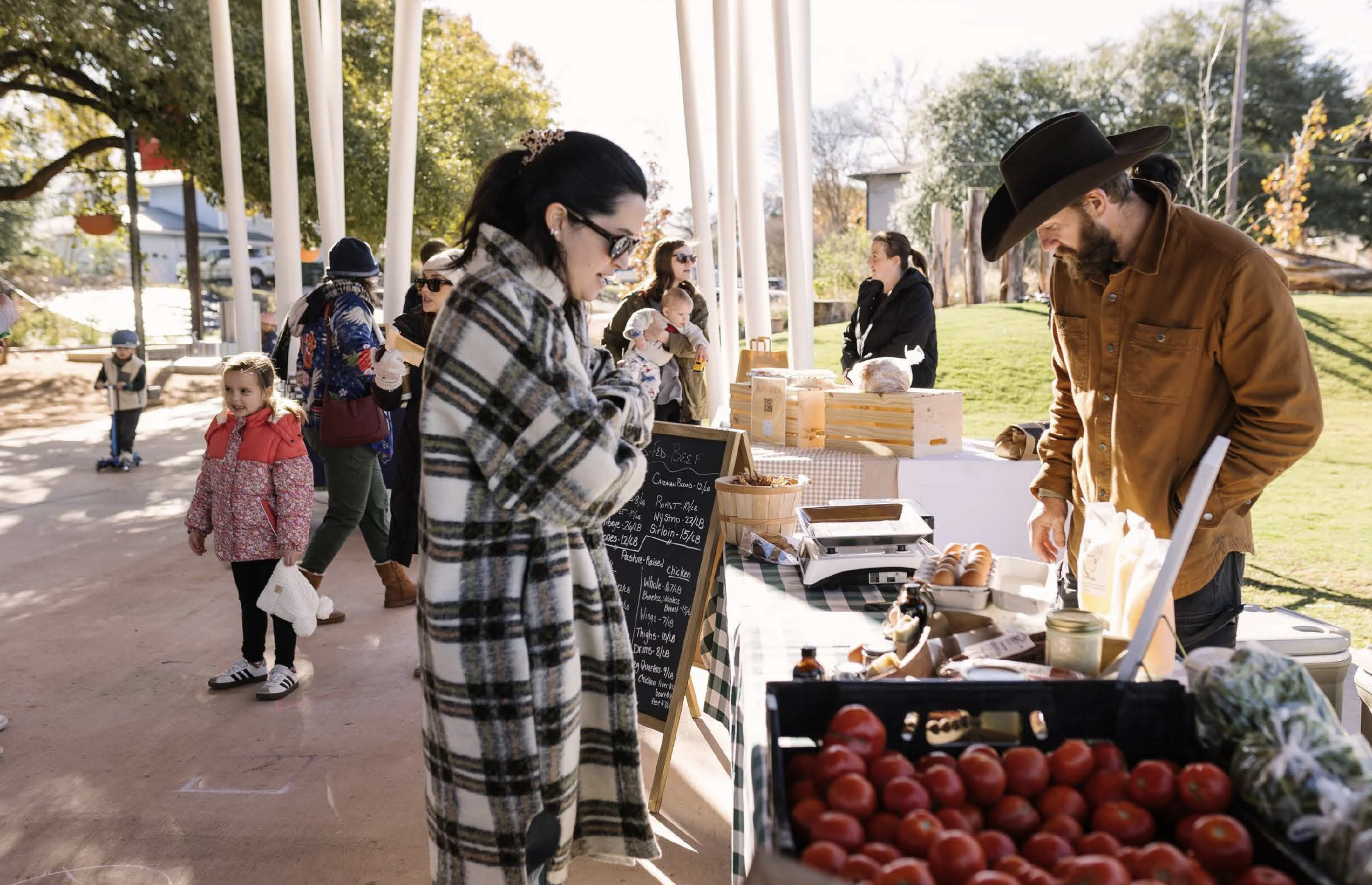
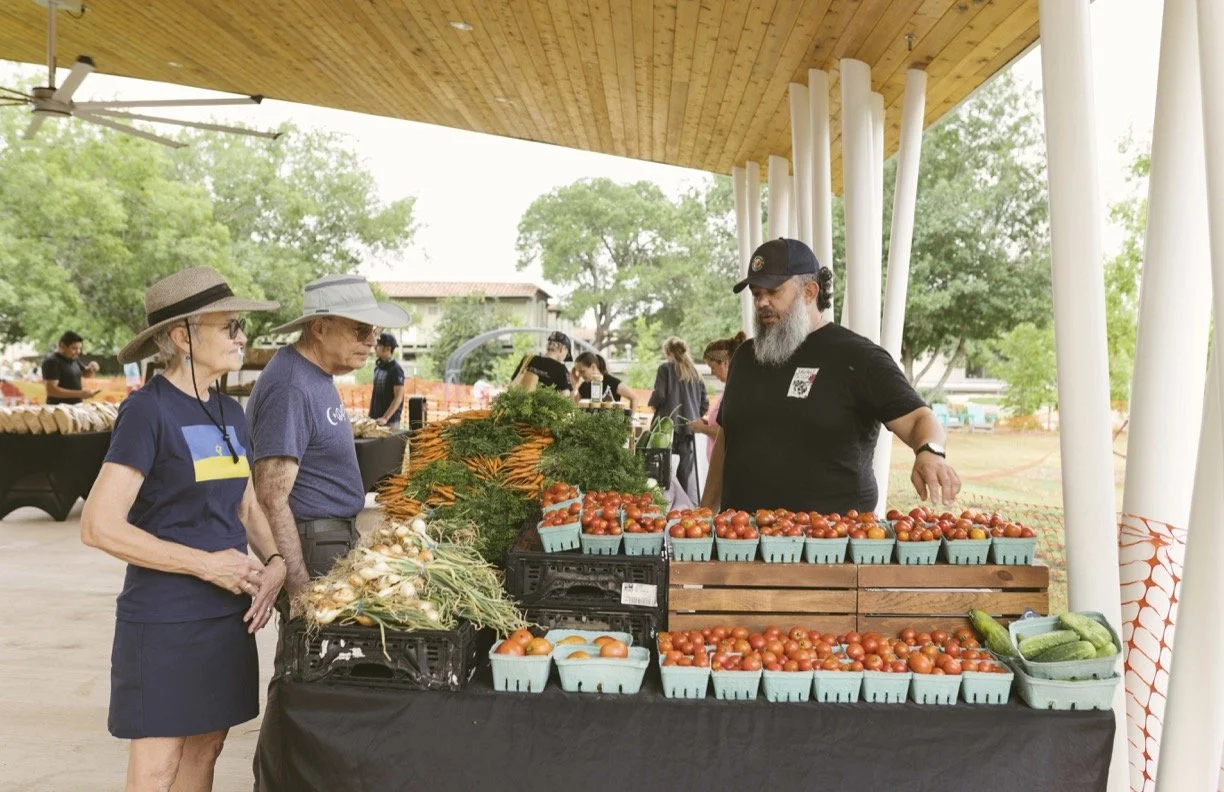
The anchor of this economic engine is the Sunset Ridge Farmers Market. Unlike typical commercial markets, this space was explicitly designed to prioritize the producer's viability over the host's profit. Sarah Clavieres, the manager of the market, recalls that after years of searching for a location, the vision for Charis Park felt like the perfect fit. "My drawings included a circular path, a natural playscape for children, native plants, a spot for live music, and a long community table," Clavieres says. "Watching the construction of Charis Park was like watching the dream of this market space be built before my eyes."
Operating under a nonprofit mission, the market removes the barriers to entry that often stifle small-scale agriculture. Clavieres and her team waive booth fees for qualifying farmers and offer $1,200 quarterly microgrants to support first-generation farmers and ranchers. "We aren't scheming how to get rich off the backs of farmers," Clavieres explains. "We recognize the time sensitivity in our city's food security and food sovereignty, and are finding ways to support the individuals who are still growing food while building topsoil, without polluting our environment."
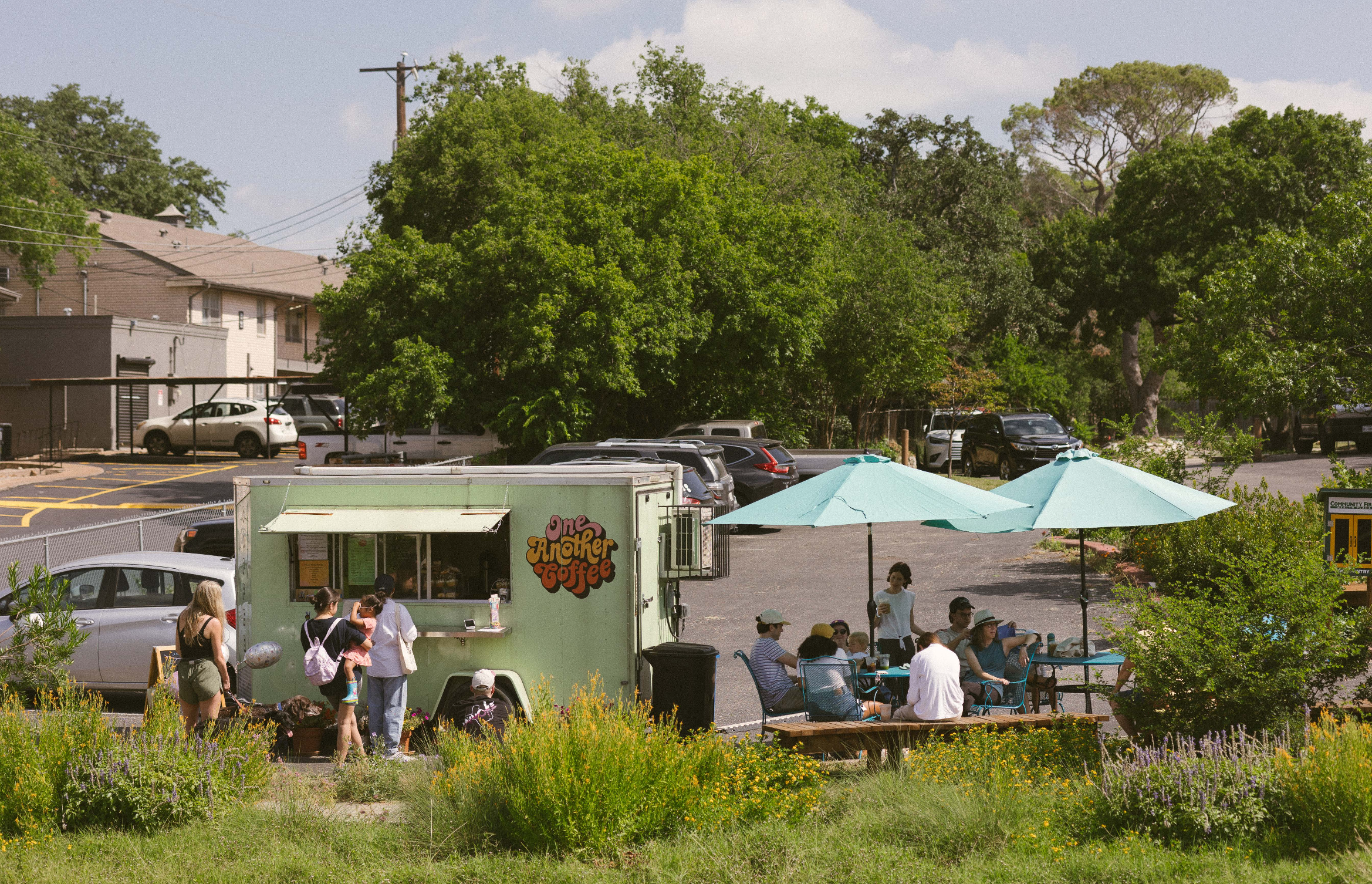
This commitment to lowering barriers has triggered a surge in small-business incubation across the campus. The economic activity actually began before the park was even finished, when Rose Hip Coffee launched in the middle of the vacant parking lot. That early presence sold coffee and fostered the relationships that would support the park's construction. The success of Rose Hip eventually propelled them into a brick-and-mortar location, making room for a new coffee truck, One Another Coffee, and the arrival of Scott’s Pizza.
Today, the campus is designed with dedicated food truck access and shared tenant spaces that create multiple economic loops. Revenue from these operators helps fund ongoing park maintenance, ensuring the neighborhood gift remains sustainable without draining the church’s other resources.
The long-term vision for this pillar extends into a mission-aligned wedding and event venue. This future phase aims to use the church’s historic chapel and the beauty of Charis Park to host events, supported by a network of mission-minded vendors—from bakeries to photographers—designed to provide dignified employment for under-resourced women in the community. By ensuring that every economic activity on campus connects back to a social mission, Sunset Ridge Collective proves that a circular economy can support the bottom line and nourish the entire neighborhood. As Clavieres puts it, the goal is for visitors to "participate first hand in a circular economy that nourishes our bodies and minds for us and for generations to come." Essentially, the market becomes a thriving example of a resilience hub.
Pillar 4: Learning & Education
The physical and economic shifts at Sunset Ridge are underpinned by a commitment to learning, with the campus itself serving as a living classroom. This pillar moves beyond traditional schoolhouse walls, repositioning the natural world and the neighbors themselves as the primary teachers. By integrating formal early childhood education with spontaneous sharing, Sunset Ridge Collective has created a site where wisdom is not just preserved, but actively practiced.
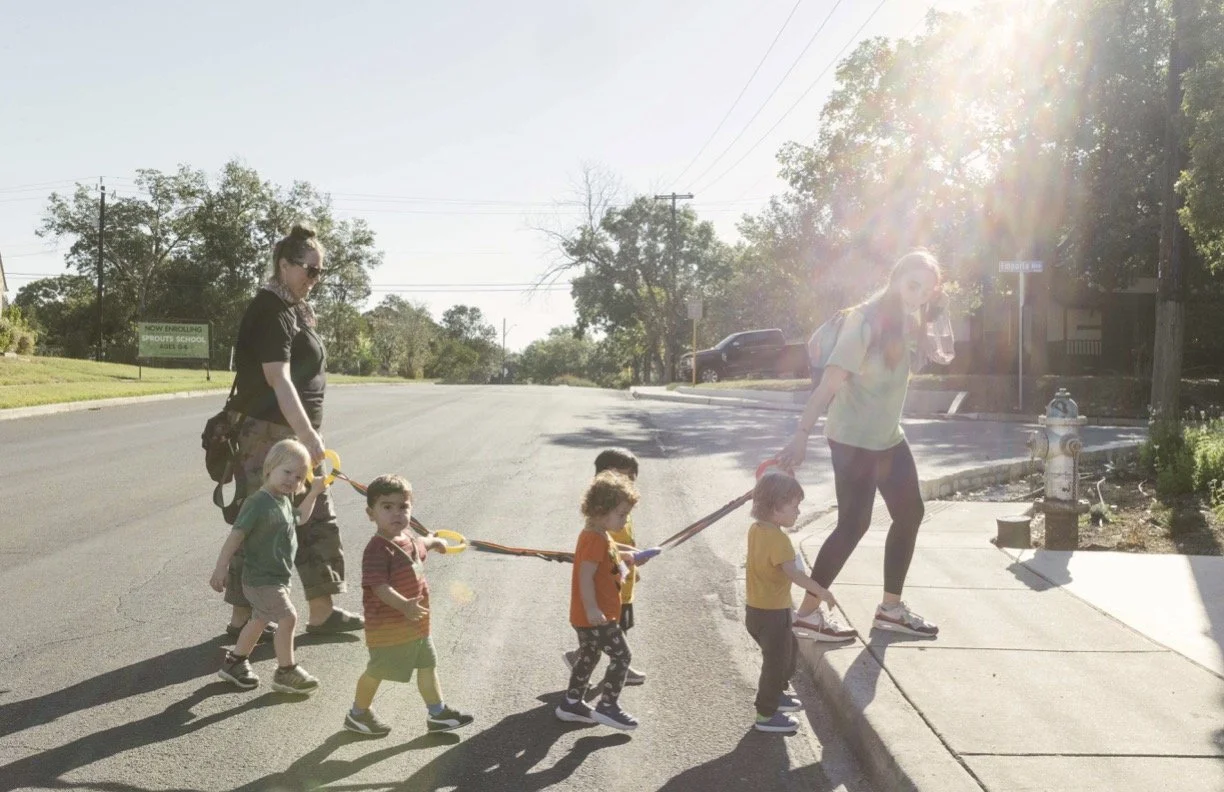
The most structured element of this educational ecosystem is the Sprouts School, a nature-based Montessori program integrated into daily campus life that supports families with children from six weeks to six years. Rooted in the values of curiosity and exploration, the school offers a learning model that mirrors the design of the park itself. The school’s waitlist serves as a clear indicator of the neighborhood's demand for an education that prioritizes deep connections with others and the natural world. When at the park, Sprouts’ children learn through the exploratory play that Coral Studios intentionally designed into the landscape, using the rolling hills and native gardens as their primary laboratory.
This educational mission extends to the adults in the community through vendor-led workshops and cooperative skill-sharing. Clavieres notes that the Farmers Market is a chance for the community to learn about and participate in an alternative economic system and to enjoy the opportunity to "choose something better.” Market vendors lead free community sessions on composting, seed saving, and regenerative agriculture, while recurring "Mending Circles" foster an intergenerational exchange of practical skills. More than teaching a craft, these gatherings build community capacity and shared resilience, allowing neighbors to teach neighbors how to care for their belongings and their environment.
The site also teaches by grounding the community in the place's historical story. The design of the park serves as a physical reminder of the Texas Blackland Prairie ecoregion and the site's history as a place of restoration. Nguyen explains that the goal was "to make people feel connected to the land and a feeling of ownership by using history as inspiration for the design." By drawing on the site’s 1920s history as the Woodmen of the World Memorial Hospital, the Collective has reclaimed the land’s original purpose as a "healing space," now reimagined for a new century.
Through hands-on stewardship events like Community Garden Work Days, the Collective combines ecological education with communal labor. These events transform the act of weeding or planting into a lesson in interdependence, fostering a shared identity as environmental stewards and ensuring that each new generation that uses the park creates fond memories while learning what it means to be part of a thriving, circular system.
Pillar 5: Health & Well-being
The final movement of the Sunset Ridge story is one of wholeness, in which the physical, social, and economic threads come together for the neighborhood's health and well-being. In alignment with the Community Flourishing Framework, the Collective addressed health as the presence of the conditions required for a community to thrive, rather than merely the absence of disease.
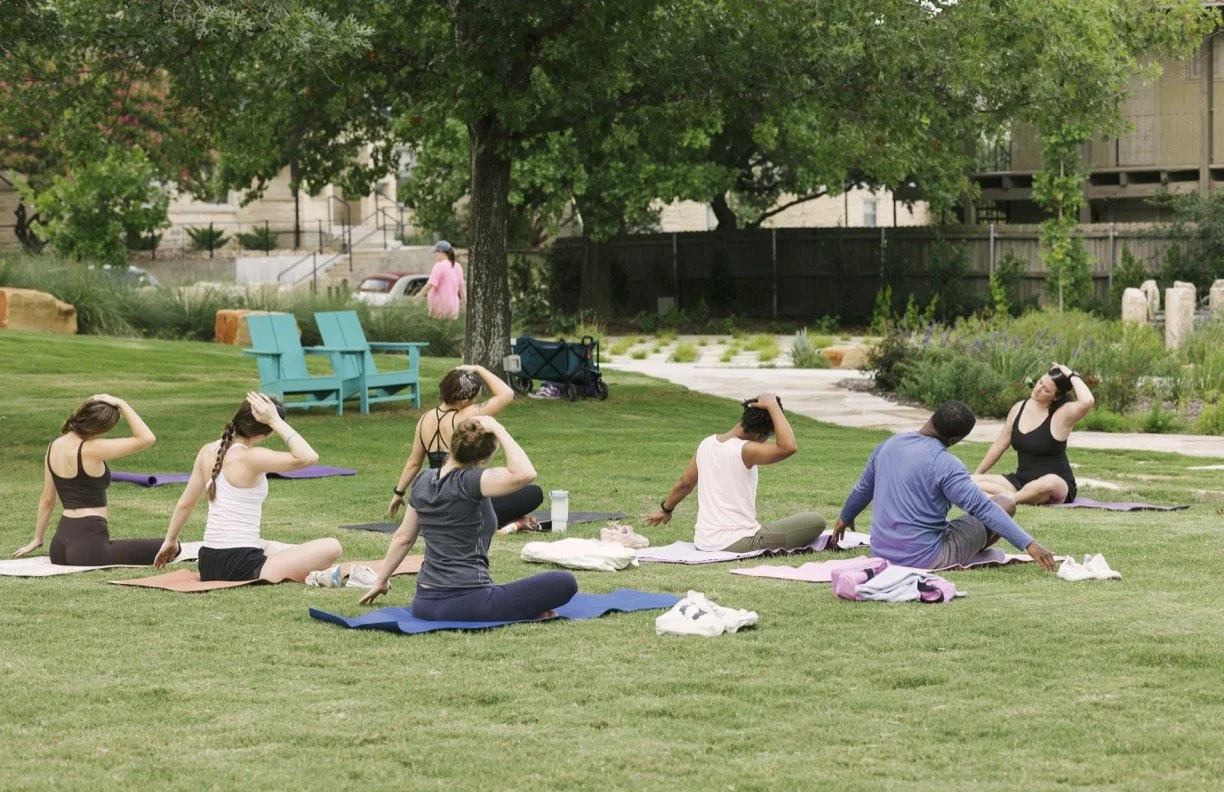
The most immediate shift involved converting the one-acre "heat island" into a walkable green sanctuary. Where asphalt once blocked connection to the earth, neighbors now have access to rolling hills, a gathering lawn, and quiet meditation gardens. This change provides a visual reprieve while making the documented health benefits of exposure to nature and physical activity available to everyone. The weekly Farmers Market further bolsters this by transforming the park into a local food distribution hub. In a neighborhood previously lacking access to fresh produce, the market offers a direct connection to regeneratively grown food.
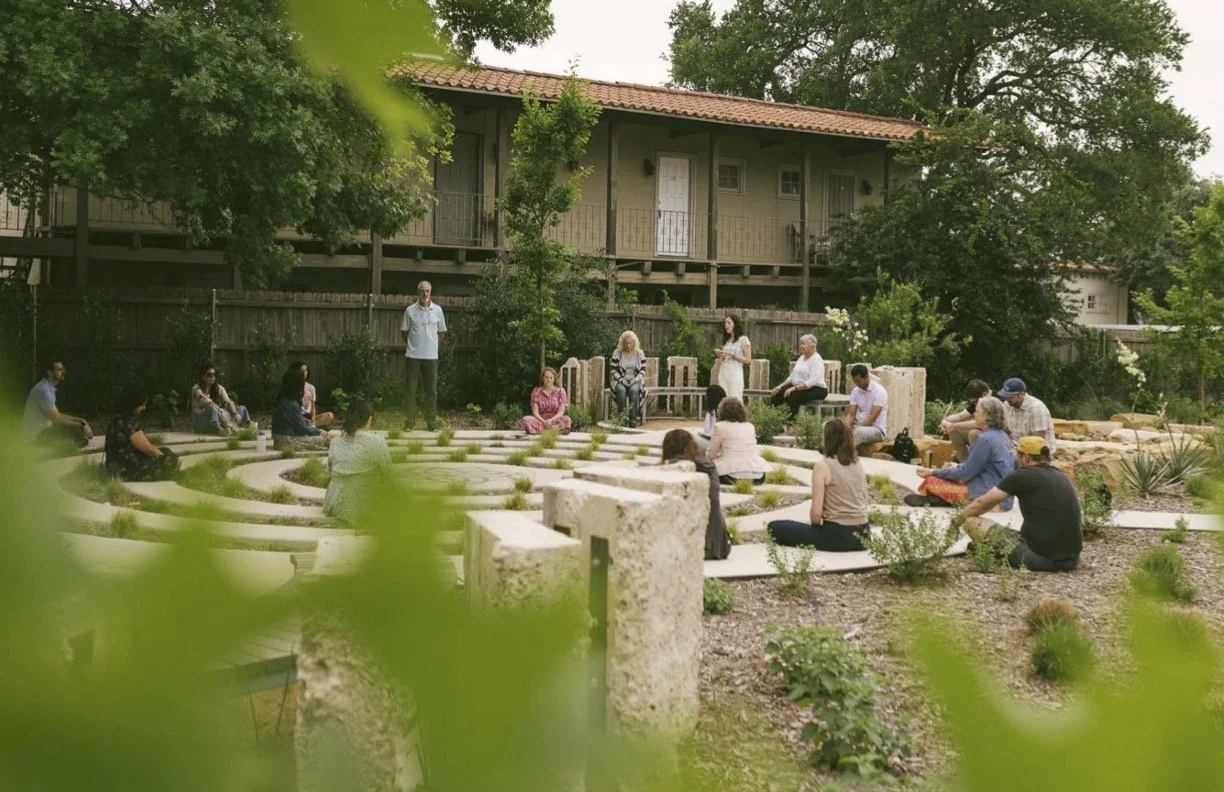
Mental health and the epidemic of loneliness served as the primary design drivers for the entire campus. Every decision—from removing physical barriers to including long community tables—was made to combat social isolation as a public health crisis. This includes spaces dedicated to spiritual and emotional flourishing, such as a labyrinth and secluded pocket gardens designed for meditation and prayer.
The health of the people is mirrored by the restoration of the land's ecological health. The installation of 3,000 native plants created a biodiverse habitat for pollinators and birds while simultaneously improving local air and water quality. The Collective also transitioned its maintenance to a regenerative model, leaving seed heads for birds, composting on-site, and eliminating chemical fertilizers. This commitment reflects a core belief of the Good Acres program: “healthy land supports healthy people.”
Ultimately, the truest metric of well-being at Sunset Ridge isn't found in a spreadsheet. It is found in the spontaneous, community-led gatherings that happen without professional programming. The real measure of success is seeing neighbors choose connection, movement, and belonging of their own accord. As Clavieres notes, the hope is that visitors "feel safe, happy, connected, and have a sense of belonging at the park and when they leave… that they feel rejuvenated." It’s when a community begins to heal itself through shared space and shared labor that the cycle of regeneration reaches its full potential.
The Way Ahead
The story of the Sunset Ridge Collective serves as a blueprint for the future of urban stewardship and reimagining the assets of people and place. In San Antonio, approximately 3,000 acres of faith-owned land sit idle as vast expanses of scorching asphalt and lifeless buildings that could be redirected toward the common good. Sunset Ridge proves these assets do not have to be liabilities or sources of institutional anxiety. Instead, they can become the "Resilience Hubs" and sources of connection our neighborhoods desperately need.
By replacing the institutional gate with a community invitation, the Collective demonstrated that the gap between available resources and neighborhood needs closes fastest when an entire community is invited into the solution. The regenerative cascade seen here—where ecological restoration, economic mobility, and social connection feed into one another—functions as a replicable model. It challenges every faith community and nonprofit to look at their own aging, underutilized infrastructure and ask not how to survive but how to help their neighbors thrive. As more organizations adopt this framework, the transformation seen at Sunset Ridge can scale across the city, turning thousands of idle acres into a vibrant, living network of community flourishing.